Skip to content

Resources

Free resources.

Worksheets on career reflection, strengths, values, feedback, and reviewing experience. Use them on your own or in coaching.

First page of Values Worksheet

Worksheet

Values Worksheet

Reflect on your values and how they inform your decisions.

Preview questions

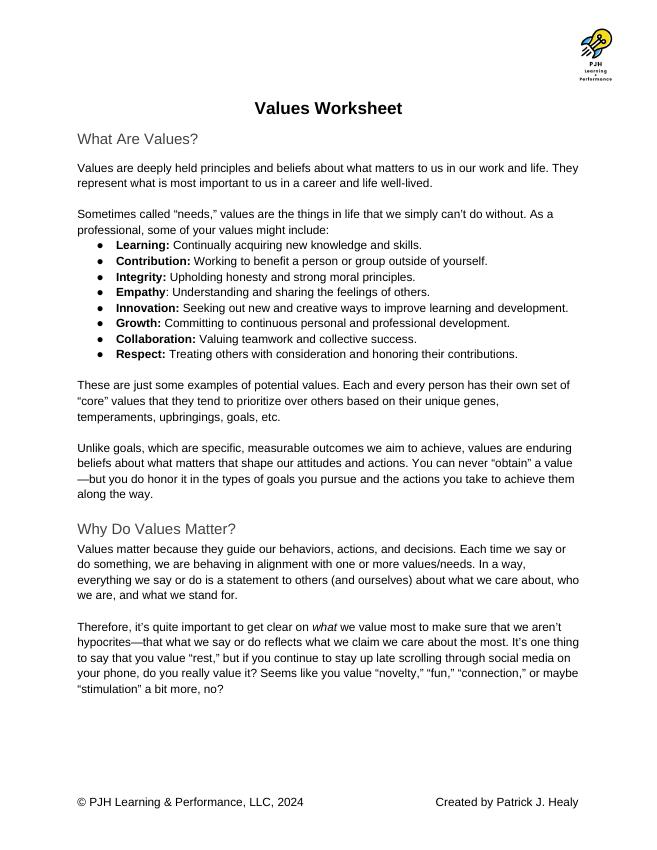
Values Worksheet

What Are Values?

Values are deeply held principles and beliefs about what matters to us in our work and life. They represent what is most important to us in a career and life well-lived.

Sometimes called “needs,” values are the things in life that we simply can’t do without. As a professional, some of your values might include:

Learning: Continually acquiring new knowledge and skills.

Contribution: Working to benefit a person or group outside of yourself.

Integrity: Upholding honesty and strong moral principles.

Empathy: Understanding and sharing the feelings of others.

Innovation: Seeking out new and creative ways to improve learning and development.

Growth: Committing to continuous personal and professional development.

Collaboration: Valuing teamwork and collective success.

Respect: Treating others with consideration and honoring their contributions.

These are just some examples of potential values. Each and every person has their own set of “core” values that they tend to prioritize over others based on their unique genes, temperaments, upbringings, goals, etc.

Unlike goals, which are specific, measurable outcomes we aim to achieve, values are enduring beliefs about what matters that shape our attitudes and actions. You can never “obtain” a value, but you do honor it in the types of goals you pursue and the actions you take to achieve them along the way.

Why Do Values Matter?

Values matter because they guide our behaviors, actions, and decisions. Each time we say or do something, we are behaving in alignment with one or more values/needs. In a way, everything we say or do is a statement to others (and ourselves) about what we care about, who we are, and what we stand for.

Therefore, it’s quite important to get clear on what we value most to make sure that we aren’t hypocrites, that what we say or do reflects what we claim we care about the most. It’s one thing to say that you value “rest,” but if you continue to stay up late scrolling through social media on your phone, do you really value it? Seems like you value “novelty,” “fun,” “connection,” or maybe “stimulation” a bit more, no?

How To Use Values

Identifying your core values and utilizing them in your daily work can have a profound impact on your career and life. Getting clear on what actually matters to you most, not what matters to others, what you think you “should” value, etc., and regularly reminding yourself of what you value can lead to more consistent and authentic behavior, improved decision-making, and increased satisfaction in your career and personal life. Furthermore, prioritizing your values can help you to more intentionally navigate decisions, challenges, and transitions.

Part I - Identify Your Values

To leverage your values, you first need to determine what they are. Here is a quick and easy exercise to help you do that.

Step 1: Reflect on Your Values

Think about times when you felt the most fulfilled and content. Where were you? Who was there? What were you doing? What values or needs of yours were being honored?

Consider times of frustration or conflict. What values were being suppressed or ignored? What was missing or lacking?

Step 2: Identify Core Values

Based on your reflections from Step 1, list 20 values that are most important to you in a career and life well-lived:

You might explore these comprehensive lists of values for examples and inspiration:

Brené Brown’s List of Values

James Clear’s List of Core Values

Scott Jeffrey’s Core Values List

Step 3: Seek Feedback from Trusted Sources

Ask family members, friends, colleagues, and significant others what they think matters to you. Record what they have to say too:

Step 4: Prioritize Your Values

Review the 20 or so values you identified in Steps 2 and 3. Then, pick out your top 10 values. These should be things in life that matter to you the most, the kinds of things that, if you didn’t have, would result in a pretty sucky career or life

Step 5: Create a Values Statement

Develop a clear and concise values statement describing what you value, why, and how you currently honor it. Put it somewhere where you can see it to remind yourself of what you want your career or life to stand for.

Part II - Harness Your Values

It’s one thing to have a values statement. It’s another to actually use it. Here are some ways you might harness your newly discovered values

Activity 1: Values Assessment

On a scale of 0 (not at all) to 10 (completely), rate how well you are currently honoring each of your core values. (Warning: If your current goals and actions are NOT aligned with your values, this exercise may be pretty sobering).

For values you are honoring, congratulate yourself for living with integrity! For values you aren’t honoring so much and want to honor more, think about what’s getting in the way. What is preventing you from living out this value? How can overcome these barriers and honor this value more?

Activity 2: Set Values-Based Goals

Pick one core value you’d like to honor more. Set a goal for doing that in the next year, quarter, month, or week. Make sure the goal is:

Specific - it’s clear what you will do

Measurable - you can assess the extent to which you succeeded

Actionable - it’s clear how to move forward with it

Realistic - you have a high likelihood of success given your current time and resources

Time-bound - there’s a deadline

For example, if you value “growth” and want to challenge yourself more, you might set a goal to “Complete one 10-week online course in programming by the end of this quarter.”

Set a values-based goal below:

Activity 3: Create a Plan and Align Your Daily Actions

Choose a goal you have that aligns with one of your values. Then, develop an action plan describing how you will achieve it. What will you do? When? Where? How much or how frequently?

For example, if you set a “growth” goal to complete a 10-week programming course by the end of this quarter, you might sketch out what activities will be required, how often you will study, when and where you will allocate time in your schedule, and so on. You might use a planner and calendar to

Activity 4: Make Values-Based Decisions

If you need to make an important decision, you can also use your core values to assess potential options. For the options you’re considering, rate how well you think they align with each of your values on a scale of 0 (not at all) to 10 (completely).

Option 1:

Option 2:

Option 3:

Activity 5: Conduct a Values Inventory

Values can change over time. So, it’s important to reflect regularly on your core values to determine how relevant they still are.

For each of your core values, consider how important it is to you at this stage of your career or life. You might still value it, but not as much as earlier.

Ask yourself, is it still worthy of being a core value? Or has it fallen off? Are there other values would you like to honor now?
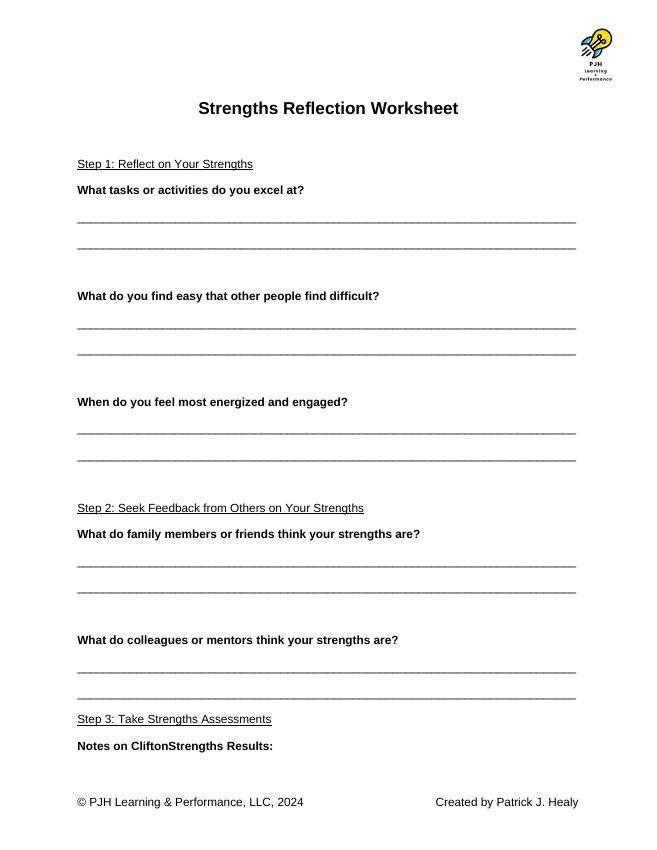
First page of Strengths Reflection

Worksheet

Strengths Reflection

Reflect on your strengths, seek others’ perspectives, and plan how to use and develop them.

Preview questions

Strengths Reflection Worksheet

Step 1: Reflect on Your Strengths

What tasks or activities do you excel at?

What do you find easy that other people find difficult?

When do you feel most energized and engaged?

Step 2: Seek Feedback from Others on Your Strengths

What do family members or friends think your strengths are?

What do colleagues or mentors think your strengths are?

Step 3: Take Strengths Assessments

Notes on CliftonStrengths Results:

Notes on VIA Character Strengths Results:

Notes from Other Assessments:

Step 4: Analyze Common Patterns to Determine Your Very Top Strengths

Based on the results from Steps 1-3, my top 5 strengths/skills are:

[STRENGTH 1]

[STRENGTH 2]

[STRENGTH 3]

[STRENGTH 4]

[STRENGTH 5]

Step 5: Identify Ways You Can Leverage Your Strengths

In what ways are you currently applying your strengths in your career or role?

In what ways can you apply your strengths more effectively or often?

In what ways can you utilize your strengths to make up for some of your weaknesses/areas for improvement?

In what ways can you further develop your strengths?

Step 6: Set Some Strengths-Based Goals

Goal #1: I aim to…

Action Plan #1: I will accomplish this goal by…

Goal #2: I aim to…

Action Plan #2: I will accomplish this goal by…

Goal #3: I aim to…

Action Plan #3: I will accomplish this goal by…

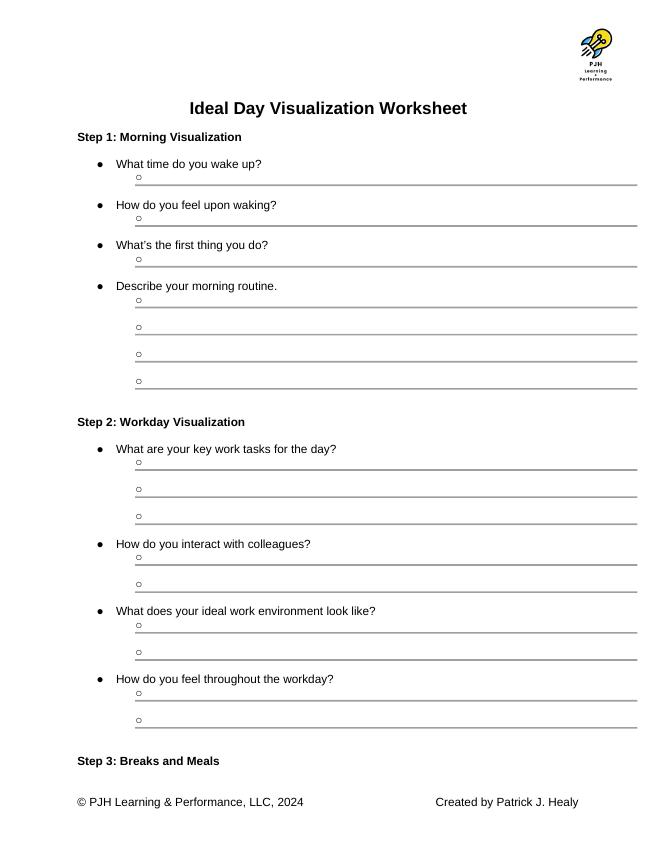
First page of Ideal Day Visualization

Visualization

Ideal Day Visualization

Imagine a day you would enjoy, and notice what it tells you about your priorities.

Preview questions

Ideal Day Visualization Worksheet

Step 1: Morning Visualization

What time do you wake up?

How do you feel upon waking?

What’s the first thing you do?

Describe your morning routine.

Step 2: Workday Visualization

What are your key work tasks for the day?

How do you interact with colleagues?

What does your ideal work environment look like?

How do you feel throughout the workday?

Step 3: Breaks and Meals

When and how do you take breaks?

Describe your ideal lunch break.

Step 4: Personal Time and Activities

What personal activities do you include in your day?

How do you balance personal and professional time?

Step 5: Evening Visualization

How do you wind down in the evening?

What activities help you relax and recharge?

When do you go to bed?

How do you feel as you end your ideal day?

Step 6: Reflection

Write down the key elements of your ideal day.

First page of Professional Mission Statement

Worksheet

Professional Mission Statement

Bring together your goal, contribution, purpose, and values. Written for talent development professionals.

Preview questions

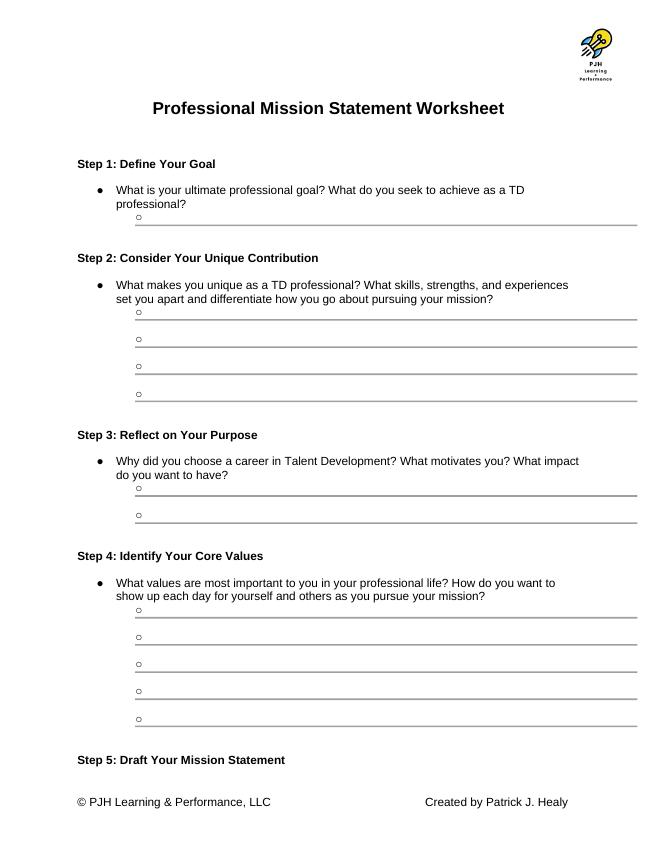
Professional Mission Statement Worksheet

Step 1: Define Your Goal

What is your ultimate professional goal? What do you seek to achieve as a TD professional?

Step 2: Consider Your Unique Contribution

What makes you unique as a TD professional? What skills, strengths, and experiences set you apart and differentiate how you go about pursuing your mission?

Step 3: Reflect on Your Purpose

Why did you choose a career in Talent Development? What motivates you? What impact do you want to have?

Step 4: Identify Your Core Values

What values are most important to you in your professional life? How do you want to show up each day for yourself and others as you pursue your mission?

Step 5: Draft Your Mission Statement

Combine your goal, unique contribution, purpose, and values into a clear and concise statement.

“My mission is to _______________________________________.

I pursue my mission by _______________________________________.

I do it because _______________________________________.

Along the way, I strive to ________________________________.

Step 6: Refine and Share

Review your statement and refine it until it resonates with you. Seek feedback from trusted colleagues or mentors.

My Professional Mission Statement

First page of Career Legacy Exercise

Exercise

Career Legacy Exercise

Imagine looking back on your career. Use that view to guide today's choices.

Preview questions

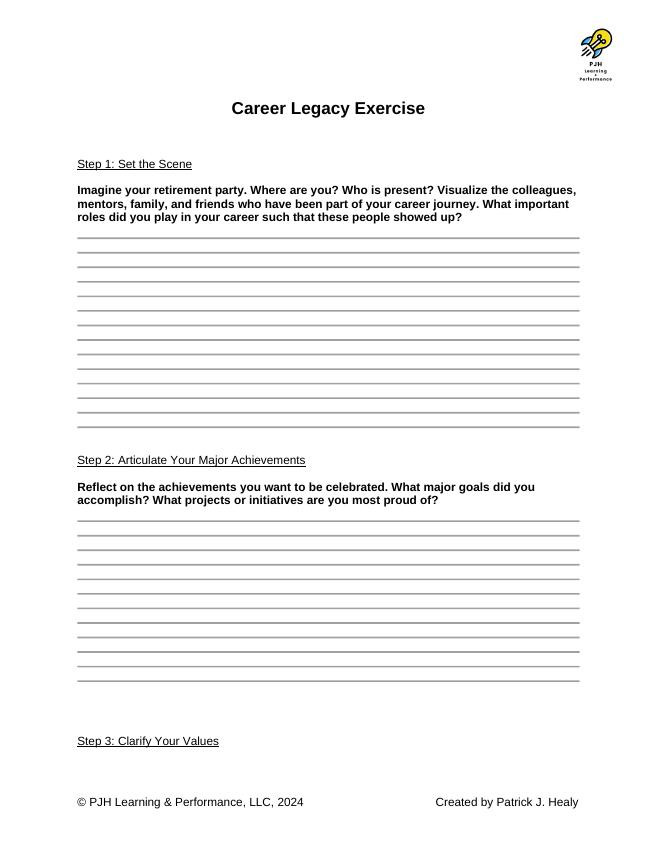
Career Legacy Exercise

Step 1: Set the Scene

Imagine your retirement party. Where are you? Who is present? Visualize the colleagues, mentors, family, and friends who have been part of your career journey. What important roles did you play in your career such that these people showed up?

Step 2: Articulate Your Major Achievements

Reflect on the achievements you want to be celebrated. What major goals did you accomplish? What projects or initiatives are you most proud of?

Step 3: Clarify Your Values

Define the qualities and values you want to be recognized for. What important values did your career stand for? How do you want others to describe how you showed up with them?

Step 4: Describe Your Desired Impact

Envision the impact you have had on others. What positive changes have you contributed to? How have you inspired and supported others along the way?

Step 5: Write the Toasts

Write down what you hope people would say about you in their toasts to you. What would they say about how you showed up with them and the effect you had on their lives?

Step 6: Write Your Speech

Tie the reflections from steps 1 to 5 together to write your own speech. If you had 10-15 minutes to speak about your career, what would you say?

First page of Career Story Worksheet

Worksheet

Career Story Worksheet

Reflect on your experience and find a way to talk about it in interviews and conversations.

Preview questions

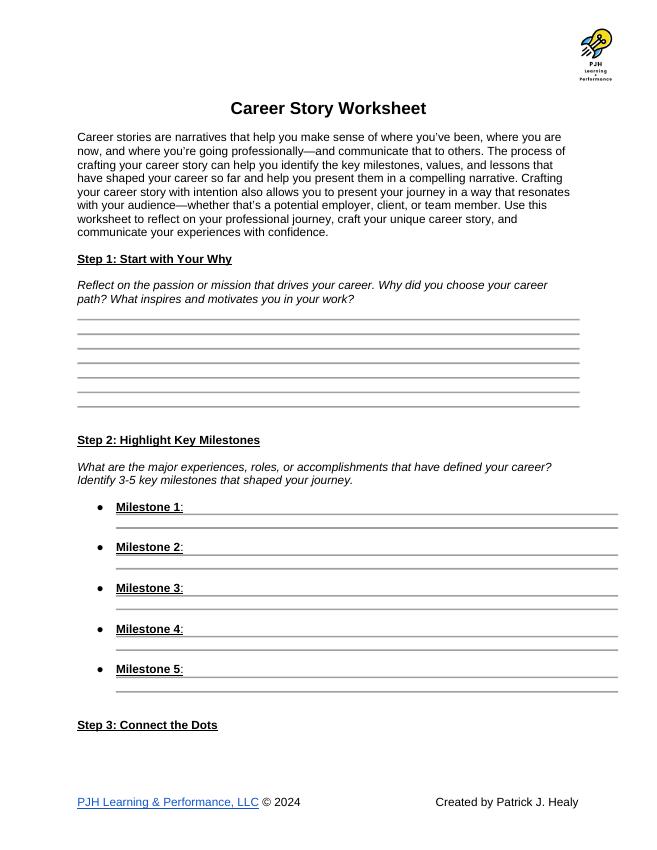
Career Story Worksheet

Career stories are narratives that help you make sense of where you’ve been, where you are now, and where you’re going professionally, and communicate that to others. The process of crafting your career story can help you identify the key milestones, values, and lessons that have shaped your career so far and help you present them in a compelling narrative. Crafting your career story with intention also allows you to present your journey in a way that resonates with your audience, whether that’s a potential employer, client, or team member. Use this worksheet to reflect on your professional journey, craft your unique career story, and communicate your experiences with confidence.

Step 1: Start with Your Why

Reflect on the passion or mission that drives your career. Why did you choose your career path? What inspires and motivates you in your work?

Step 2: Highlight Key Milestones

What are the major experiences, roles, or accomplishments that have defined your career? Identify 3-5 key milestones that shaped your journey.

Milestone 1:

Milestone 2:

Milestone 3:

Milestone 4:

Milestone 5:

Step 3: Connect the Dots

Reflect on how your career has progressed and describe how these milestones are connected. How did one experience lead to the next? What challenges did you navigate, and what lessons did you learn along the way?

Step 4: Emphasize Growth and Impact

How have you grown professionally and personally throughout your career? What impact have you made on teams, organizations, or clients? Reflect on how you’ve contributed to the success of others or solved important problems.

Step 5: Look to the Future

What are your career goals for the future? Where do you see yourself going next, and how do your past experiences position you for success?

Step 6: Craft Your Career Story

Using your answers from the previous steps, craft a 3-5 paragraph career story. Make sure to touch on your why, your key milestones, your growth, and your future goals.

Step 7: Practice, Practice, Practice

Once you’ve crafted your story, practice sharing it with others, whether in interviews, networking conversations, or mentoring relationships. Get feedback from others on it and revise it to make it even more impactful. Happy storytelling!

First page of Professional Brand Worksheet

Worksheet

Professional Brand Worksheet

Decide how you want to be known and how to show that in your work.

Preview questions

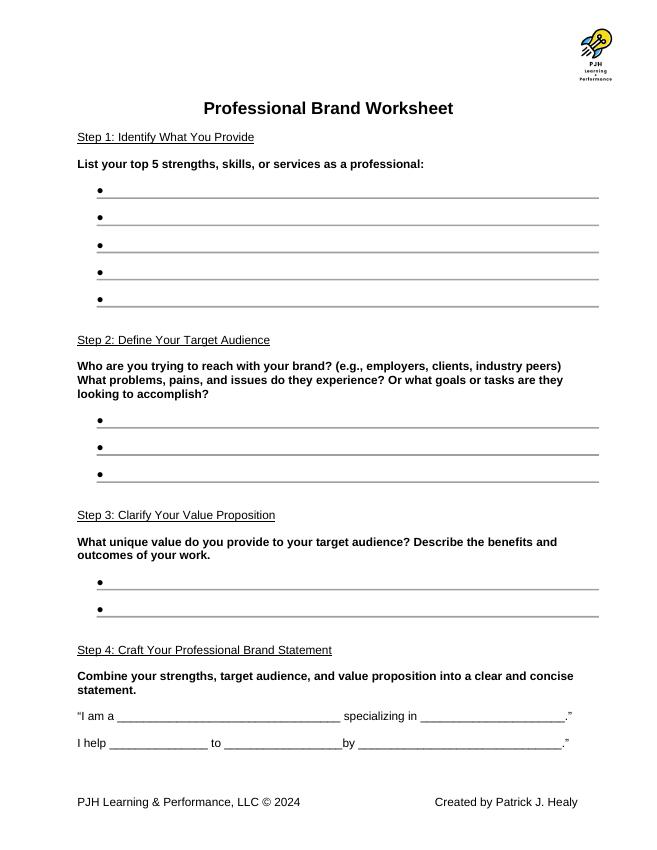
Professional Brand Worksheet

Step 1: Identify What You Provide

List your top 5 strengths, skills, or services as a professional:

Step 2: Define Your Target Audience

Who are you trying to reach with your brand? (e.g., employers, clients, industry peers) What problems, pains, and issues do they experience? Or what goals or tasks are they looking to accomplish?

Step 3: Clarify Your Value Proposition

What unique value do you provide to your target audience? Describe the benefits and outcomes of your work.

Step 4: Craft Your Professional Brand Statement

Combine your strengths, target audience, and value proposition into a clear and concise statement.

“I am a __________________________________ specializing in ______________________.”

I help _______________ to __________________by _______________________________.”

Step 5: Revise and Refine

Review your statement and refine it until it clearly communicates your brand. You might seek feedback from trusted colleagues or mentors and test it out with a few members of your target audience before communicating it more broadly.

Final Personal Brand Statement:

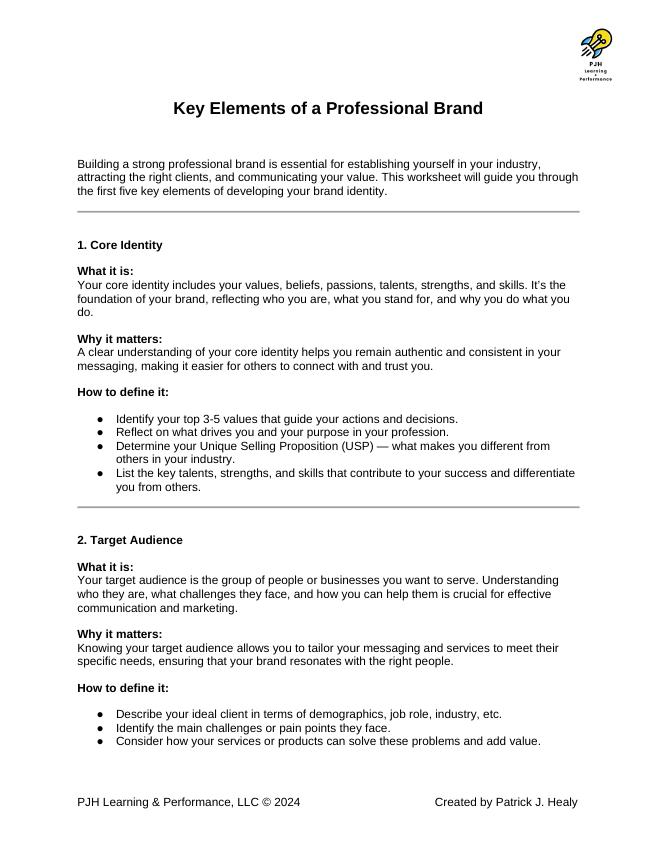
First page of Key Elements of a Professional Brand

Guide

Key Elements of a Professional Brand

An introduction to building a professional brand that reflects who you are.

Preview questions

Key Elements of a Professional Brand

Building a strong professional brand is essential for establishing yourself in your industry, attracting the right clients, and communicating your value. This worksheet will guide you through the first five key elements of developing your brand identity.

1. Core Identity

What it is:Your core identity includes your values, beliefs, passions, talents, strengths, and skills. It’s the foundation of your brand, reflecting who you are, what you stand for, and why you do what you do.

Why it matters:A clear understanding of your core identity helps you remain authentic and consistent in your messaging, making it easier for others to connect with and trust you.

How to define it:

Identify your top 3-5 values that guide your actions and decisions.

Reflect on what drives you and your purpose in your profession.

Determine your Unique Selling Proposition (USP) , what makes you different from others in your industry.

List the key talents, strengths, and skills that contribute to your success and differentiate you from others.

2. Target Audience

What it is:Your target audience is the group of people or businesses you want to serve. Understanding who they are, what challenges they face, and how you can help them is crucial for effective communication and marketing.

Why it matters:Knowing your target audience allows you to tailor your messaging and services to meet their specific needs, ensuring that your brand resonates with the right people.

How to define it:

Describe your ideal client in terms of demographics, job role, industry, etc.

Identify the main challenges or pain points they face.

Consider how your services or products can solve these problems and add value.

3. Brand Positioning

What it is:Brand positioning is how you want to be perceived in the market. It involves creating a clear, concise statement that communicates your brand’s purpose and the unique value you offer.

Why it matters:Effective brand positioning helps you stand out from competitors and makes it clear to potential clients what you can do for them and why they should choose you.

How to define it:

Craft a brand statement that summarizes who you are, what you do, and the value you provide.

Consider the personality traits you want your brand to convey (e.g., approachable, professional, innovative).

Differentiate yourself by highlighting what makes your approach or services unique.

4. Visual Identity

What it is:Your visual identity includes the colors, fonts, logos, and imagery associated with your brand. It’s the visual representation of your brand’s personality and values.

Why it matters:A consistent and appealing visual identity makes your brand more recognizable and memorable. It also helps convey the right message to your audience at a glance.

How to define it:

Choose colors and imagery that represent your brand’s values and evoke the desired emotions in your audience.

Think about the design of your logo and how it reflects your brand.

Select fonts and other design elements that align with your brand personality.

5. Messaging and Content Strategy

What it is:Your messaging and content strategy involves the key messages you want to communicate and the themes or topics you’ll focus on in your content. It’s how you convey your brand’s value and connect with your audience.

Why it matters:Clear, consistent messaging helps establish your brand’s voice and ensures that your audience understands the value you offer. A well-planned content strategy keeps your audience engaged and builds trust over time.

How to define it:

Develop key messages that communicate your value proposition and resonate with your target audience.

Establish content pillars , the main themes or topics that will guide your content creation.

Consider how you can use storytelling to make your content more relatable and impactful.

Next Steps:

After reviewing and understanding these key elements, you’re ready to start building the foundation of your professional brand. Use the accompanying worksheet to reflect on each element and begin crafting a brand that authentically represents who you are and what you offer.

First page of Feedback Worksheet

Worksheet

Feedback Worksheet

Plan whom to ask for feedback, what to ask, how to listen, and how to act on what you hear.

Preview questions

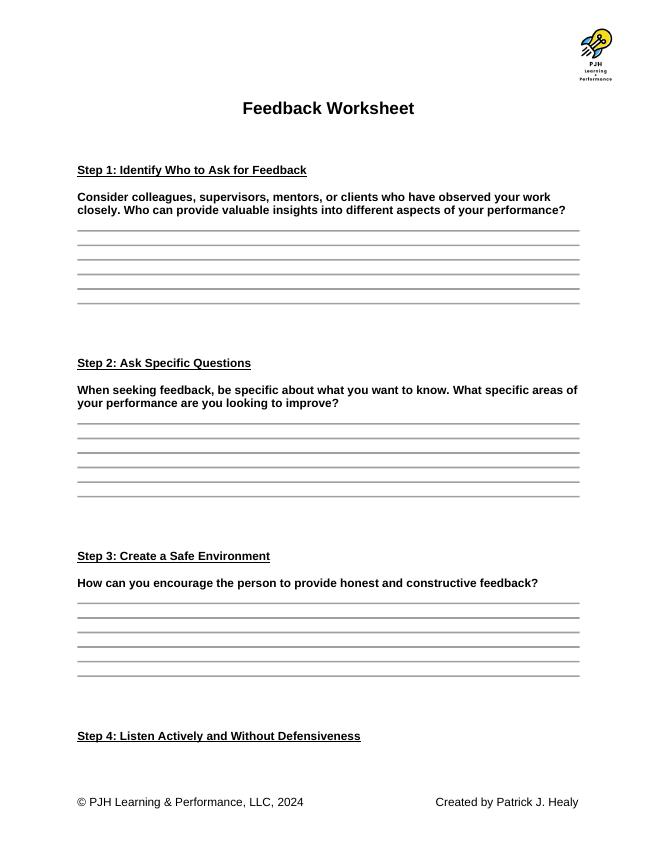
Feedback Worksheet

Step 1: Identify Who to Ask for Feedback

Consider colleagues, supervisors, mentors, or clients who have observed your work closely. Who can provide valuable insights into different aspects of your performance?

Step 2: Ask Specific Questions

When seeking feedback, be specific about what you want to know. What specific areas of your performance are you looking to improve?

Step 3: Create a Safe Environment

How can you encourage the person to provide honest and constructive feedback?

Step 4: Listen Actively and Without Defensiveness

When receiving feedback, focus on listening rather than responding. What strategies will you use to remain open and receptive?

Step 5: Reflect on the Feedback

After receiving feedback, take some time to reflect on it. How does the feedback align with your own self-perception? Where might there be gaps?

Step 6: Act on the Feedback

Create a plan to address the feedback you’ve received. What specific goals or actions will you take based on the feedback?

First page of After-Action Review

Template

After-Action Review

A simple template to reflect on a project, meeting, or milestone and learn from it.

Preview questions

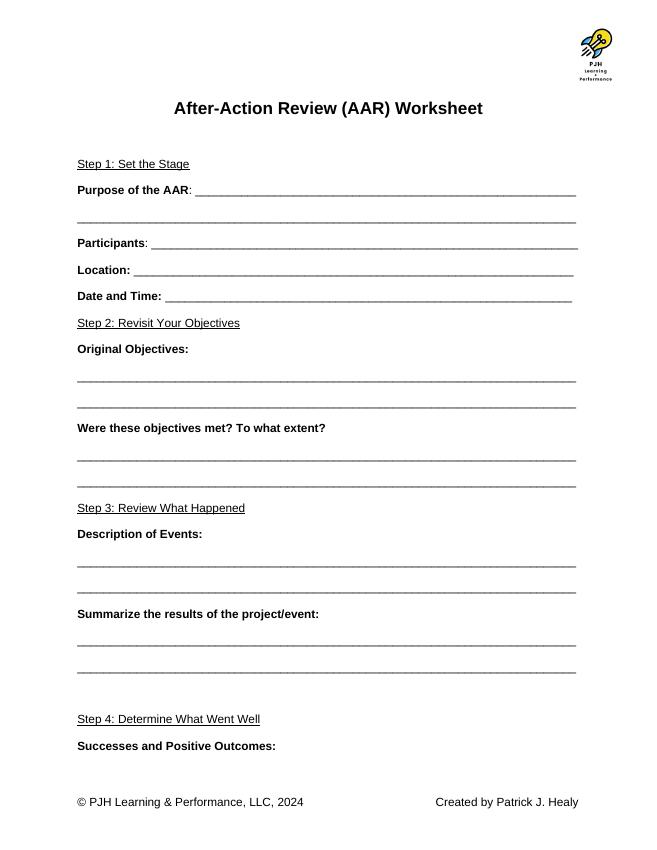
After-Action Review (AAR) Worksheet

Step 1: Set the Stage

Purpose of the AAR: __________________________________________________________

Participants: _________________________________________________________________

Location: ___________________________________________________________________

Date and Time: ______________________________________________________________

Step 2: Revisit Your Objectives

Original Objectives:

Were these objectives met? To what extent?

Step 3: Review What Happened

Description of Events:

Summarize the results of the project/event:

Step 4: Determine What Went Well

Successes and Positive Outcomes:

Reasons for Success:

Step 5: Determine What Didn’t Go Well

Challenges and Issues:

Reasons for Challenges:

Step 6: Determine Lessons Learned

Key Takeaways:

Application to Future Projects:

Step 7: Create Action Steps

Action Steps:

Next time, we will:

Continue: ____________________________________________________________________

Start: _______________________________________________________________________

Stop: _______________________________________________________________________

Change: _____________________________________________________________________

Do More/Less: ________________________________________________________________

Responsibilities and Timelines for Implementation

Future Review Meeting:

Date, Location, and Time: ______________________________________________________

Want help putting these to work?

The worksheets are free to use on your own. If you would like support applying them, we can talk it through.